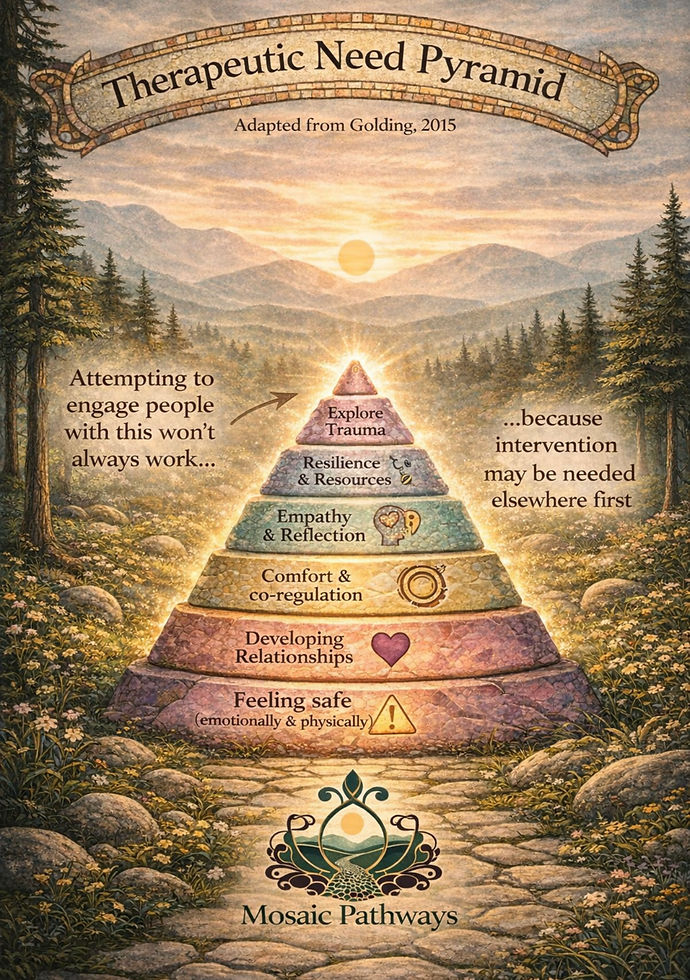
The Therapeutic Need Pyramid: Why We Can’t Start at the Top
- Emily Moore
- Mar 21
- 2 min read

At Mosaic Pathways, one of the most common things we see is this:
People come into therapy wanting to “just process the trauma.”
And that makes complete sense. When something painful has happened, we naturally want relief. We want answers. We want it to stop affecting us.
But here’s the truth that often gets missed:
We can’t always start at the top of the pyramid.
🌿 What Is the Therapeutic Need Pyramid?
The Therapeutic Need Pyramid (adapted from Golding, 2015) is a simple but powerful way to understand how healing actually works.
It reminds us that trauma work is not the first step—it’s the last step.
Before we can safely explore trauma, there are foundational needs that must be in place.
🧱 The Foundation: Feeling Safe
At the very bottom is feeling safe—emotionally and physically.
If your nervous system feels unsafe, overwhelmed, or constantly on edge, your brain is in survival mode.
And when you’re in survival mode, processing trauma can actually make things worse.
Safety isn’t just about your environment—it’s about your internal sense of stability.
💜 Building Relationships
Next comes developing relationships.
Healing does not happen in isolation.
It happens in connection—with a therapist, with safe people, and eventually with yourself.
If trust isn’t there yet, trauma work won’t stick.
🔄 Comfort & Co-Regulation
Before we can regulate ourselves, we often need co-regulation—someone helping us feel grounded.
This might look like:
Learning breathing techniques
Using grounding tools
Having a therapist who can help you “come back” when things feel too big
This stage is about teaching your body:
“You’re not alone anymore.”
🪞 Empathy & Reflection
Here we begin to make sense of our internal world.
This is where insight grows:
Understanding patterns
Naming emotions
Exploring thoughts without judgment
This step builds the bridge between survival and awareness.
🌱 Resilience & Resources
Before trauma processing, we build internal resources.
These are your tools:
Coping skills
Emotional tolerance
Ability to stay present when things feel uncomfortable
This is what makes trauma work safe and effective—not overwhelming.
🔺 The Top: Exploring Trauma
Only after all of these layers are supported do we move into trauma processing (like EMDR).
And here’s the key:
If we skip the lower levels, trauma work can destabilize instead of heal.
That’s why therapy can sometimes feel slow or structured.
It’s not because you’re “not getting to the point”—it’s because your therapist is helping you build a foundation that will actually hold.
💡 Why This Matters
You might have thought:
“Why are we not talking about the trauma yet?”
“Why does this feel like skill-building instead of therapy?”
“I just want to get to the root.”
The answer is:
We are getting to the root. We’re just making sure the ground is stable first.
🌄 The Mosaic Pathways Perspective
At Mosaic Pathways, we believe healing is not about rushing—it’s about creating a path that lasts.
Your story is important.
Your pain is valid.
And your nervous system deserves to feel safe enough to process it.
Because when the foundation is strong,
trauma work becomes not just possible—but transformative.


Comments